Klinio Review: Can Klinio Manage Diabetes?
This Klinio review contains my professional opinion about Klinio.
What is Klinio?
Klinio is a subscription-based diabetes management and weight loss app that promises to “manage diabetes through the power of habit”.

They claim to offer an intuitive, fully personalized experience for you, by you, providing “a personalized and science-based solution for managing diabetes and prediabetes”.
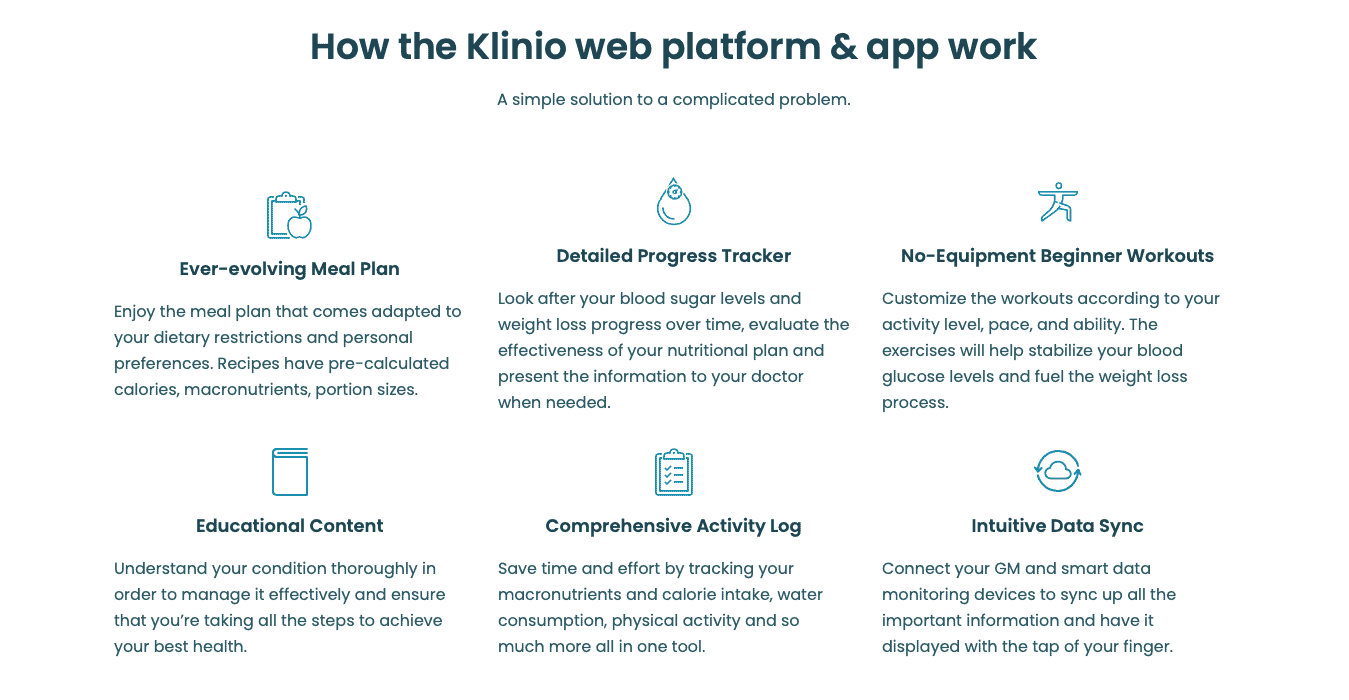
Since it can be hard to access RD services to teach management of diabetes and pre diabetes, an online option that’s more affordable would be super helpful – and this is what Klinio appears to be…at least at first.
Some countries provide diabetes education for free, some are covered through insurance, however some free programs have long wait times. With GP’s becoming less available/not taking on new patients, AI may be the future of chronic disease management. But does Klinio manage diabetes?
This Klinio review will find out.
The umbrella company behind these apps, Kilo Health, is based in Lithuania. Klinio is part of the same machine *ahem* group that brings us Beyond Body, Keto Cycle, and DoFasting, which all use a similar platform and quiz format, and have an underlying goal of weight loss and questionable ‘personalization’.
I’ve reviewed Beyond Body before…If you’ve read that, you may have an idea of where all of this is headed.
Read my Beyond Body review here.
Ostensibly to establish some credibility, Klinio uses its validation by the Validation Institute as a selling point. The Validation Institute is an for-profit entity, which means that there’s a risk for bias. Regardless, the one thing that Klinio is validated for is that 270 users with type 2 diabetes who logged into the app 19 times, over 85+ days, saw an average 0.5 drop in their A1c.
Here’s why you should be skeptical when a company cites outcomes like these:
A 0.5% drop in A1c is considered significant, although this is the exact margin of error that has been found to exist between labs.
This data was self-reported, and lastly, we aren’t sure how many out of those 270 users actually fell into this category.
Klinio claims that women with my weight had an ’81% success rate’ with their program. But how do they define ‘success’? How was this percentage measured? What else did these people do?
There are a lot of unanswered questions here. When you see percentages like these, understand that most often, they’re just marketing. Data like this, when not cited, or transparent, is meaningless. It’s also potentially fraught with bias – bias from the company wanting to look good, bias from the small sample of people that respond to surveys and leave reviews, and many others.
How does Klinio work?
For this Klinio review, I wanted to get the full experience. I started with The Klinio intake quiz.
It began by asking me to choose what type of diabetes I have. Out of curiosity about the advice the app would give me, I selected ‘type 1,’ as this is generally the toughest type of diabetes to manage.
The quiz then asked the usual things about allergies, food preferences, and pre-existing health conditions. I noticed that there was no ‘eating disorder’ option on the list.
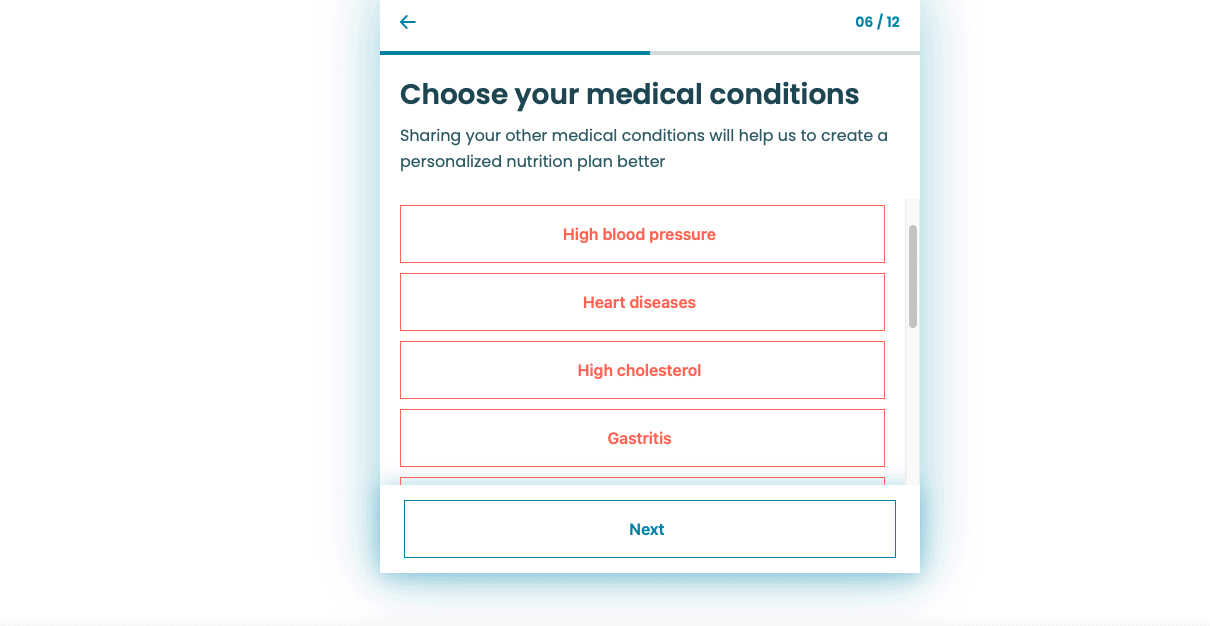
This is surprising, since 1. eating disorders, in particular in type 1 diabetics — sometimes called ‘diabulemia’ – are a real thing (and here) and 2. if a program is going to put me on a diet, basic due diligence is going to dictate that there be a safety trigger in place to prevent people with active eating disorders from using it.
Also surprising is that the quiz never asked for my medications, which is a huge red flag. How can you claim to treat or offer nutrition advice to diabetics without knowing if they’re on diabetes medications?
IT KNOWS I HAVE TYPE 1 DIABETES AND IT DIDN’T ASK ME IF I TAKE INSULIN.
This is not okay, and I’ll get to why in a moment.
Ultimately, the app asked for my age, weight, and height in order to calculate my BMI. It then wanted me to give my target weight.
I thought this was a diabetes management strategy, not a weight loss plan? Depending on the individual, sometimes weight loss is involved in diabetes management. Eating appropriately to manage your chronic health conditions doesn’t necessarily mean weight loss.
When I entered my current weight as my goal – aka I indicated that I just wanted to maintain my weight – my results said I can lose 8lb in a month – even when I didn’t say that I wanted to lose anything.
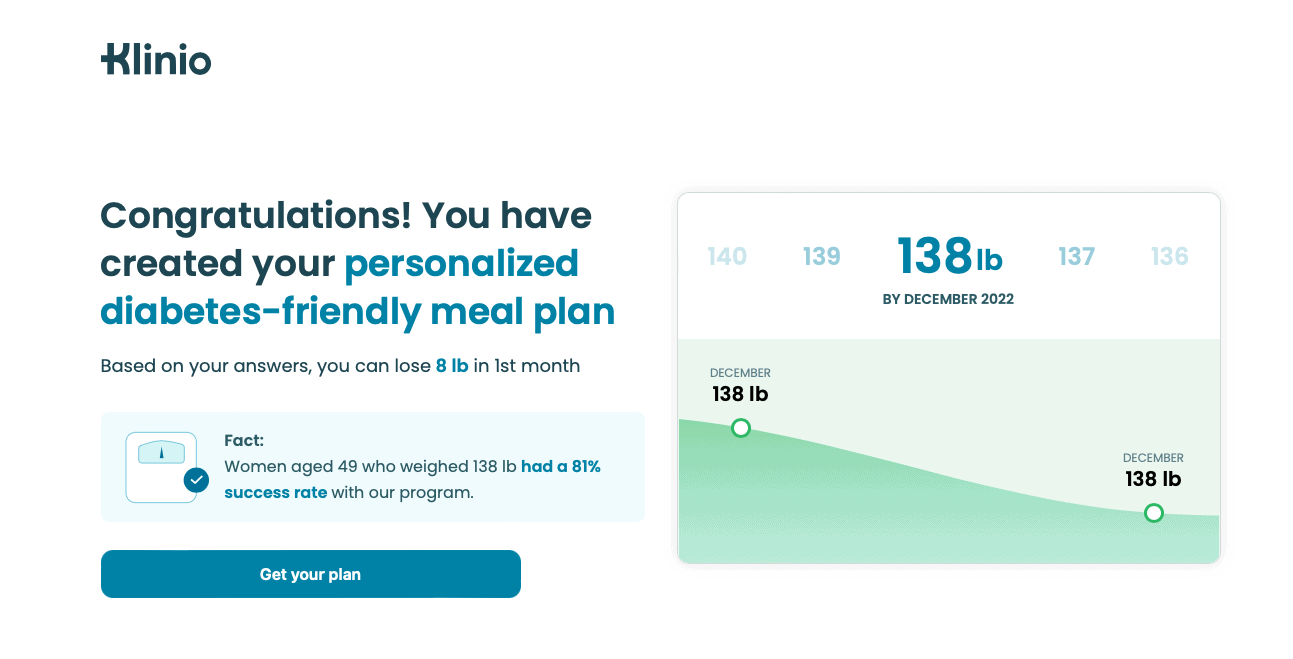
I then entered an extremely low ‘goal weight,’ to see if the app would toss out a warning or even prevent me from entering such an extreme number.
Nope. Nope to all. Klinio said they could take me from 138lb to 85lb, no problem.
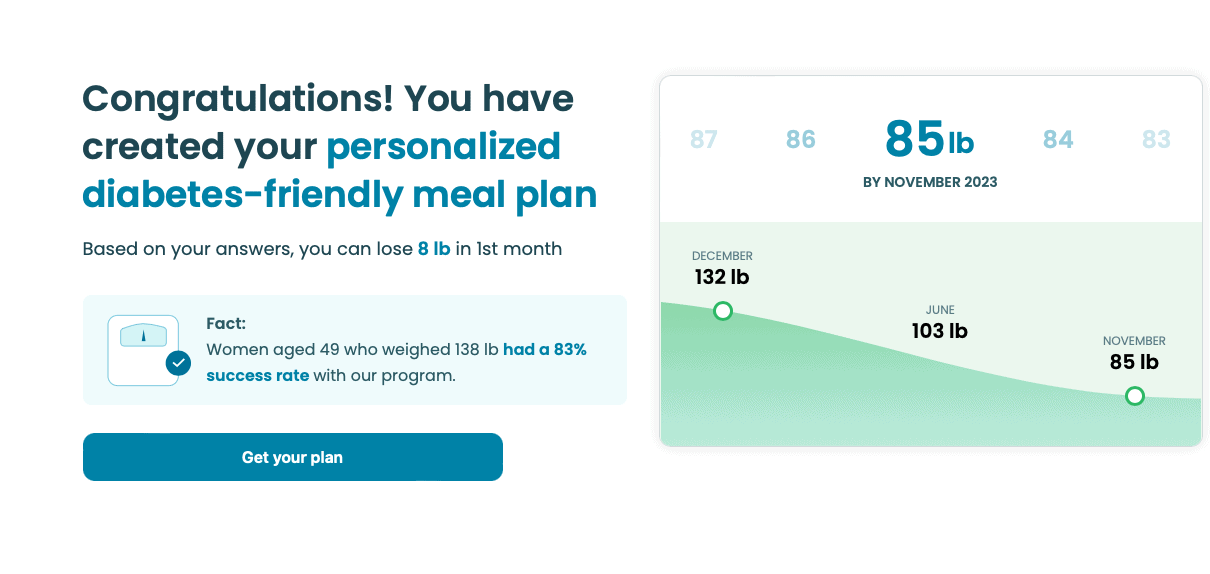
Shocked? I am too.
And although my BMI results showed as normal, Klinio was telling me that my weight is ‘a bit above the ideal range.’ That’s complete and utter garbage, and absolutely misleading.
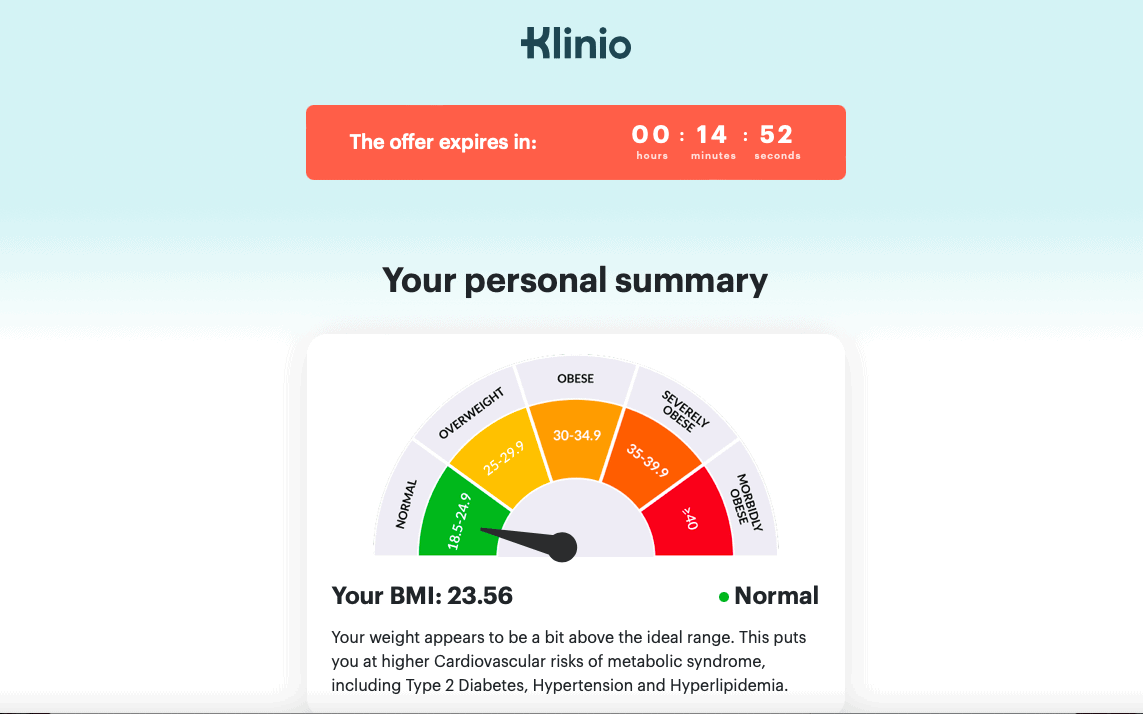
I wonder what Klinio would say if my BMI was 14.6 – what it would be if I was 85lb. A BMI below 17 is seen with anorexia, and in that sphere, one below 15 is considered to be ’extreme.’
I feel like the use of fear is one of the high-pressure techniques that Klinio uses to sell their program – in addition to ‘Buy in the next 15 minutes or it’s all gone!’ countdowns, constant emails from ‘Christine’ (if you’ve read my Beyond Body review, you’ll know Christine), and the illusion of a deep discount (get 57% off NOW!).
Klinio meal plans
By this point I was in deep, so I caved to Christine’s incessant spam emails and bought the Klinio program ($60 for 3 months) to get my ‘personalized’ meal plans and all of the other Klinio content.
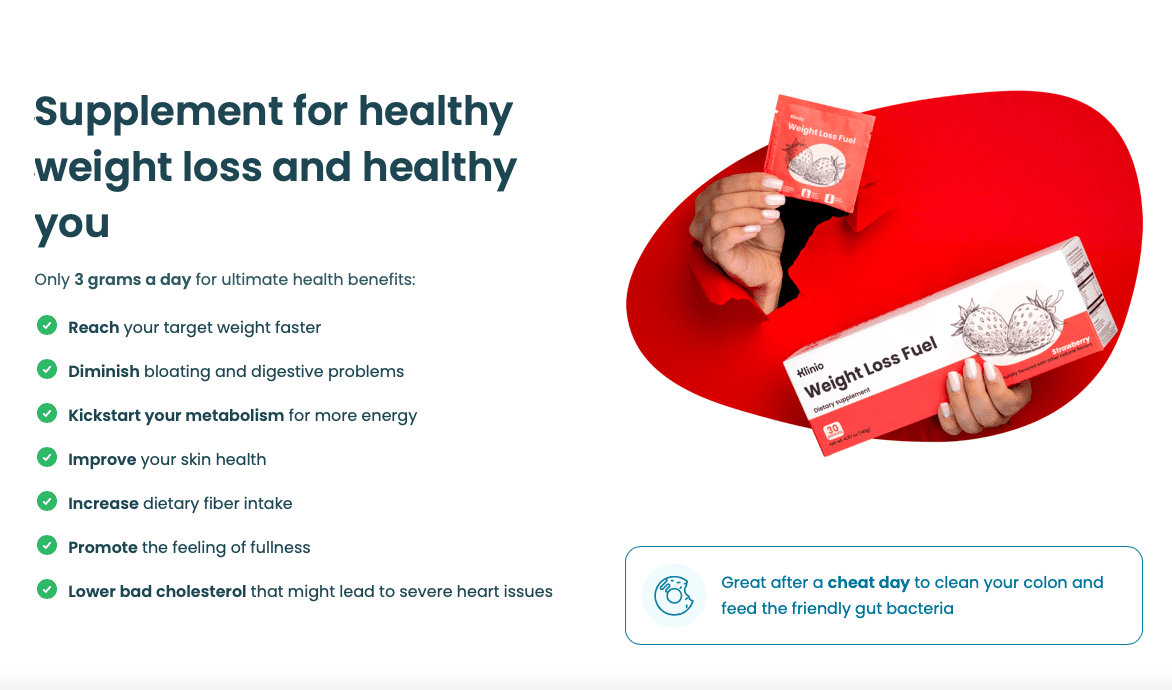
The first few screens I was shown in my paid Klinio access were for upsells. Klinio did a full-court press to try and sell me on Weight Loss Fuel, their fiber supplement that allegedly reduces cravings, ‘boosts’ metabolism and fat burn, and accelerates fat loss.
No thanks. No supplement does any of those things, and the fact that Klinio would say that Weight Loss Fuel is ‘great to clean my colon after a cheat day’ is just wrong. Like, what even is the mechanism behind that?
Then, I was asked if I wanted to purchase the Klinio cookbook and workout program, both of which should probably be included in the price but aren’t.
Although I told the app that I’m very active, Klinio gave me a diet of 1150-1300 calories a day, and allowed me to choose between a moderate carb and keto plan. I could switch back and forth between the two plans, which I did in order to see what both meal plans were offering.
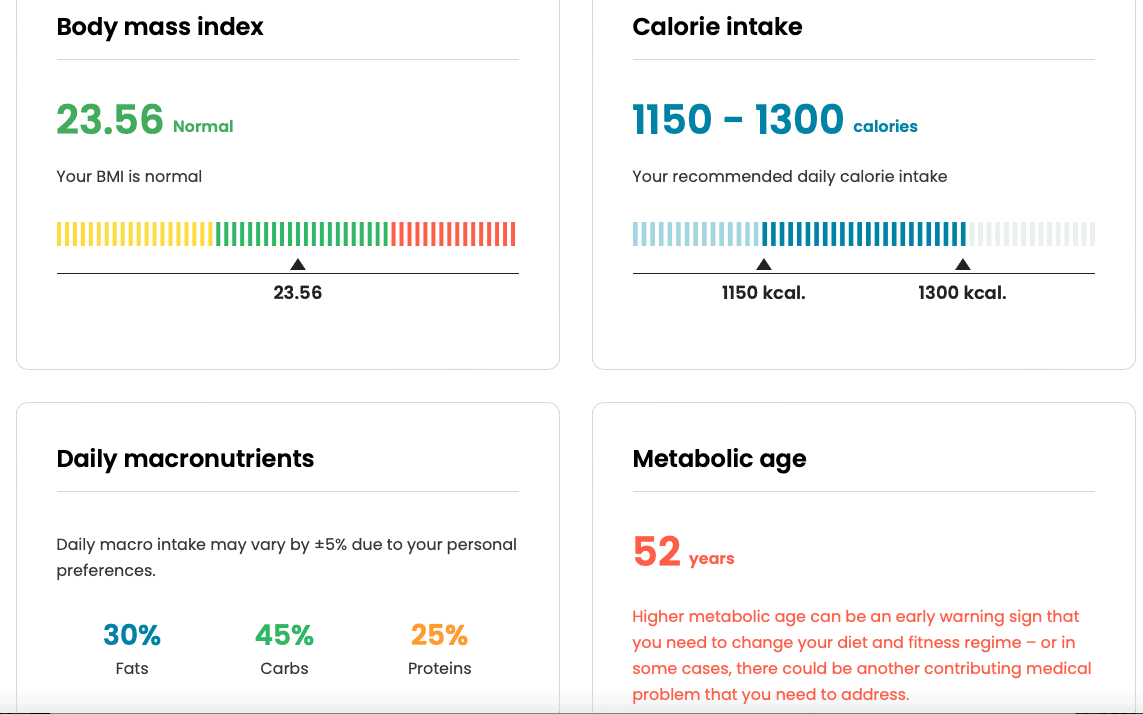
Just for your information, a toddler needs around 1200 calories a day. I am a grown woman.
Regardless of which type of diabetes you have, or even if you don’t have diabetes, this calorie level is unsustainable for most people, and can cause rebound overeating and weight gain.
Here’s an example of one day from my meal plan:
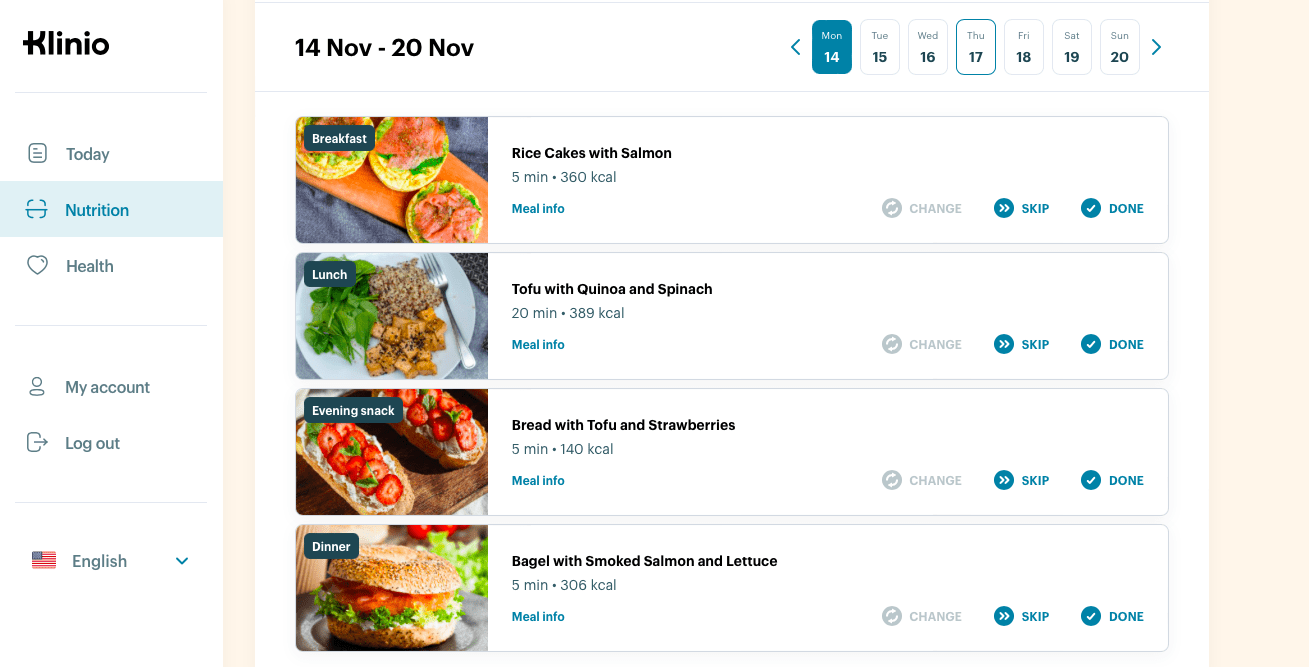
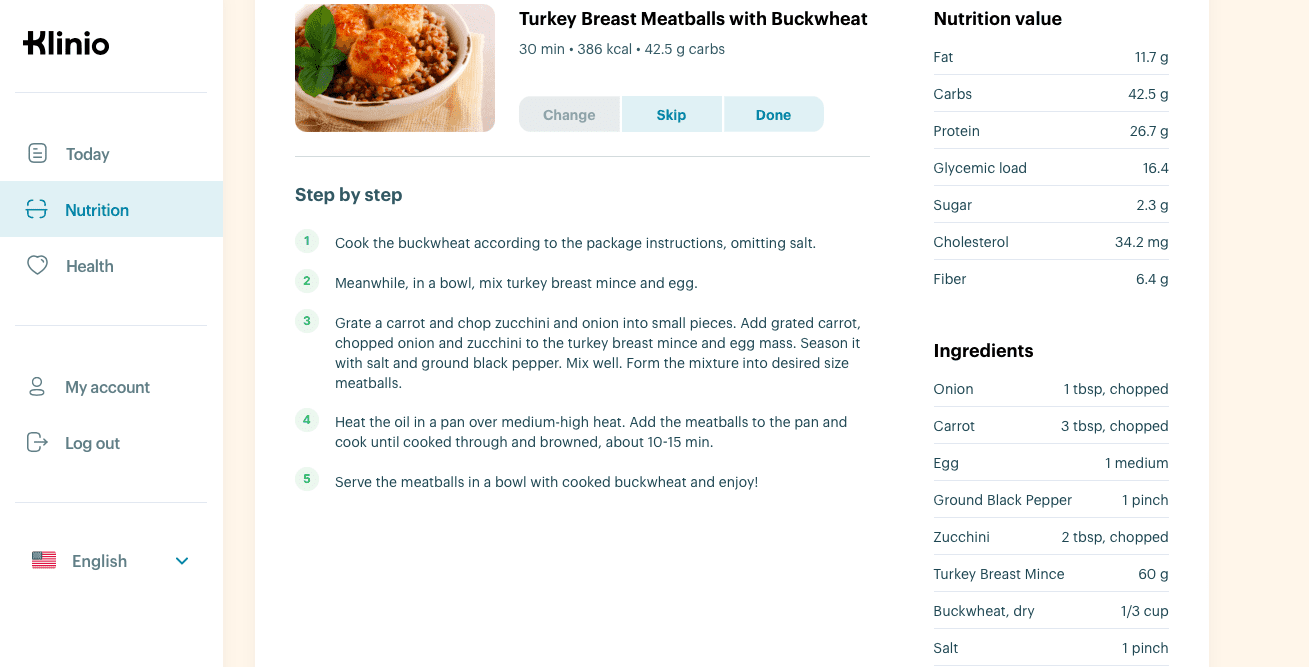
Basically, this is a low-carb/keto, low-calorie diet. The meals are tiny, and they seem to use ridiculously small amounts of ingredients that aren’t repeated, which can lead to massive amounts of food waste.
60 grams of turkey? That’s .13 of a pound or 2 ounces, exactly half of what I’d recommend as a dietitian, as the minimum amount for protein in a meal (I’d more likely recommend 5-6oz).
And 2 tablespoons of zucchini?
Seriously?
One of my breakfast choices was a green smoothie, which Klinio claims has 16.2g protein, 34.9 grams of carbs, and 306 calories.
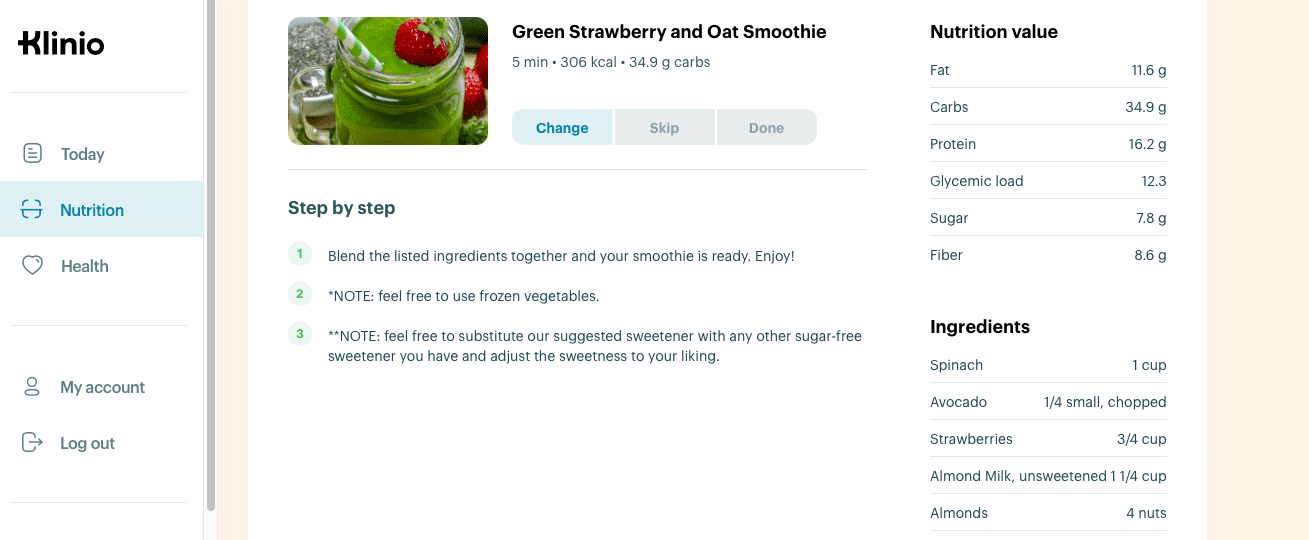
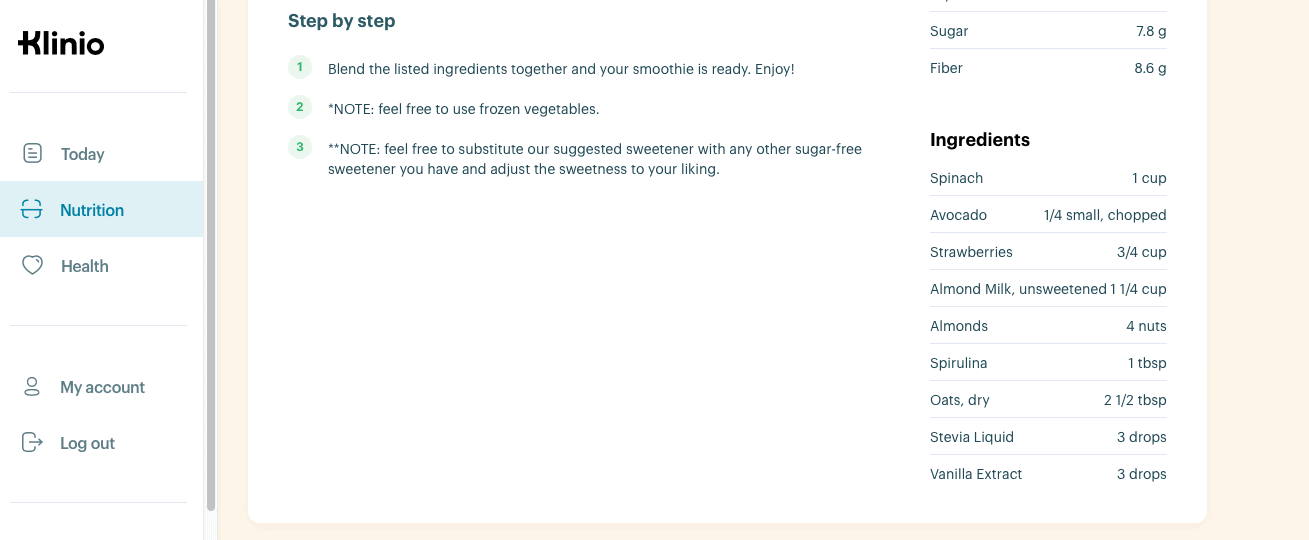
But doing the math with the listed ingredients, the calories and protein are far lower, and the carbs seem to be as well – I calculated under 20 grams, some of which are fiber (which don’t impact blood sugar).
I’m not saying that all of Klinio’s nutrition facts are inaccurate, and I may have made a mistake somewhere, but this does concern me.
As a supposed type 1 diabetic, the calorie and carb levels I was assigned are problematic.
First off, if I was really a type 1 diabetic, a diet this low in calories and carbs could very easily put me at risk for hypoglycemia – aka low blood sugar. Especially if I’m doing this diet unsupervised.
Hypoglycemia can be dangerous on its own, but some people may see their dropping blood sugars and to manage them, quit taking their insulin. That’s a whole other level of bad.
Maybe a type 2 or prediabetic would be fine on this plan, but a type 1 diabetic would need to be monitored and may have to adjust their insulin. The Keto plan option indicates that it’s ‘effective for improving type 2 and prediabetes,’ but allowed me access without question.
The app does offer glucose and insulin trackers, but these don’t replace proper medical care and oversight.
Klinio uses what appear to be thinly veiled suggestions that my health is truly in danger. As we saw above, the app told me that my BMI is normal, but then insinuated that I should still lose weight.
And on my Klinio homepage, I was told that my ‘diabetes management score’ is 59.7%, even though I had never entered in any blood sugar or blood pressure metrics. Apparently, I must ‘take immediate action’ to improve my health, which means ‘adjusting my lifestyle’ and losing weight.
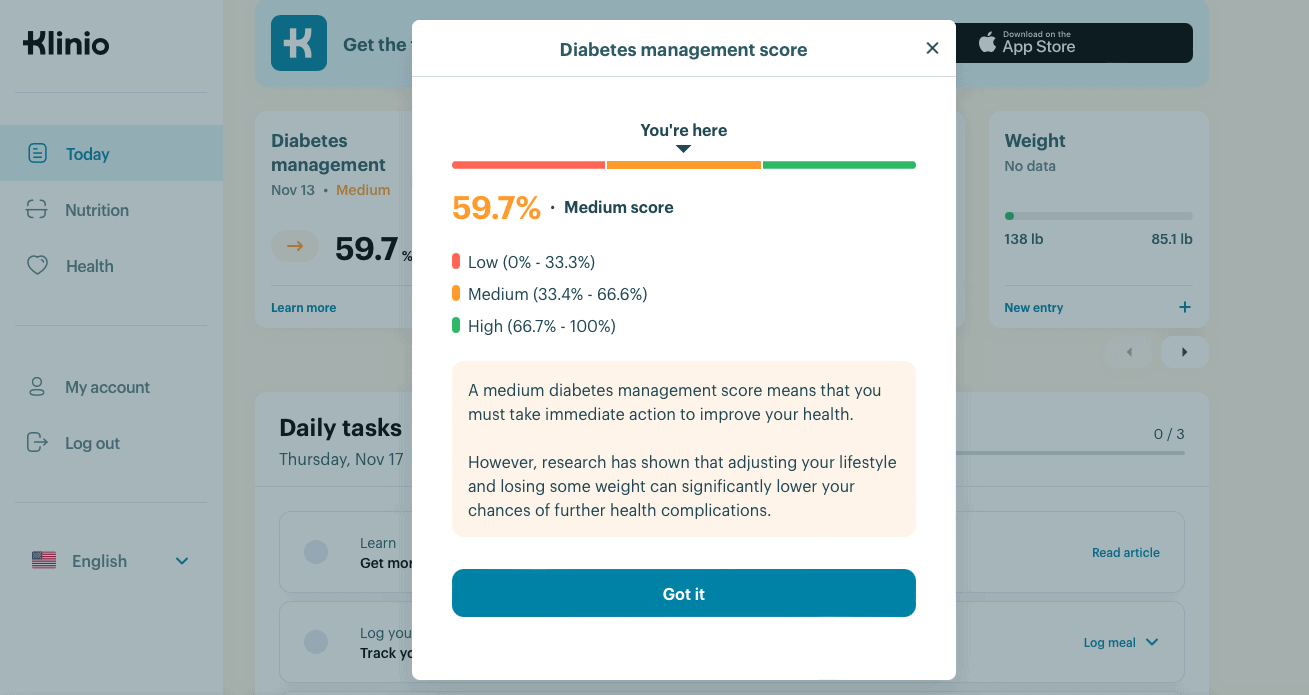
I’ve never, in 23 years as a dietitian, heard of a ‘diabetes management score,’ nor did Klinio define it or explain how they determine it.
And just like Beyond Body, Klinio determined that my ‘metabolic age’ is 52, but again, there is no indication of how they came up with this number.
Klinio has a blog with general diabetes information, but no option to speak to a dietitian or endocrinologist. Klinio, for all of its claims of being ‘personalized,’ doesn’t seem to be that in any meaningful way. The emails, the meal plan, the quiz all feel canned, and the diet is…a diet.
Klinio review: Can Klinio help manage diabetes?
Aside from the troubling hard-sell marketing, random metrics, lack of personalization, and a laser focus on weight loss, the big question with this app is whether it actually provides some useful information for diabetics.
I think that for type 2 and prediabetics, there may be some useful information in there somewhere. But type 1 diabetes is far too complex to manage via an app, especially one that’s not personalized and directly linked to your doctor.
A nutrition app that gives meal plans and advice should always have a safety trigger to red flag anyone who has an eating disorder. As a dietitian, I don’t feel like Klinio has done its due diligence there at all.
The app experience blurs the lines of ethical healthcare. When we don’t have the transparency of who is really on the other side of these virtual health platforms, it creates risks.
Giving someone the impression of safety, support, and a customized plan without providing troubleshooting, true individual assessment, and transparency can create a false sense of security.
One email I got from Klinio suggested that for individual care, that followers should consult with a professional.
This is fine, but it’s rather incongruent with what they’re advertising the app as being.
Products that provide information, reminders, new recipe suggestions, and a method to organize your goals may be helpful to some, and yes, dietary intervention in general is critical in healthy management of diabetes.
More evidence is needed to determine whether apps like these are actually helpful.
There are pros and cons to using apps for healthcare in general, but as far as using an app to manage a complex disease or condition, I think there are too many opportunities for risk.
Pass.
Co-written by Lise Wolyniuk